Art Deco Glamour: Tamara de Lempicka Soft Cubism Portrait Style


詳細
ファイルをダウンロード (1)
このバージョンについて
モデル説明
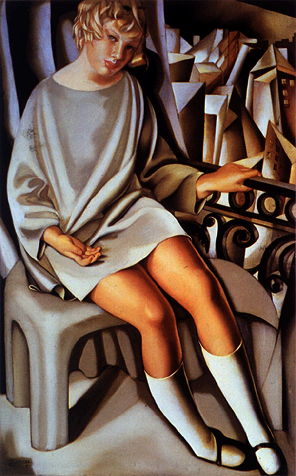
Trained on 32 portrait paintings by the Polish artist Tamara Łempicka (pronounced [taˈmara wɛmˈpit͡ska] ⓘ; 16 June 1894 – 18 March 1980),[1][2][3] known outside Poland as Tamara de Lempicka. She was a painter who spent her working life in France and the United States. She is best known for her polished Art Deco portraits of aristocrats and the wealthy, and for her highly stylized paintings of nudes. To see her works, please go to
washingtonpost.com/entertainment/art/2024/12/18/tamara-de-lempicka-paintings-style/
christies.com/en/stories/tamara-de-lempicka-collecting-guide-e78bf268274746968f5177b376081282
famsf.org/stories/5-things-to-know-art-deco-tamara-de-lempicka
tuttartpitturasculturapoesiamusica.com/2017/03/Tamara-De-Lempicka.html
tuttartpitturasculturapoesiamusica.com/2020/05/Tamara-de-Lempicka-Still-life.html
From ChatGPT:
 Lempicka's bust in Kielce, Poland
Tamara Łempicka (16 June 1894 – 18 March 1980), was a Polish-born painter best known for her bold, sensuous portraits and stylized nudes that came to define the Art Deco era. Glamorous, modern, and unapologetically ambitious, she fused the aesthetics of Cubism with Neoclassical elegance, creating a visual language that felt at once futuristic and timeless. She became the portraitist of choice for the wealthy elite of 1920s and 30s Paris, and later Hollywood.
🎨 Artistic Style
Tamara de Lempicka’s work is instantly recognizable for its:
Smooth, sculptural surfaces – reminiscent of polished marble or chrome.
Angular forms and sharp lines – borrowing from Cubism but without its abstraction.
Cool, luminous palettes – metallic grays, jade greens, icy blues, and soft skin tones.
Modern subjects – fashionable women, self-portraits, cars, skyscrapers, and sensuality.
Her figures are often painted with a cinematic glow, like golden-age film stars—elevated to the status of deities.
💃 Life and Persona
Tamara de Lempicka lived a life as extravagant and stylized as her paintings. Born in Warsaw to a wealthy family, she fled Russia after the Revolution and settled in Paris, where she studied art at the Académie de la Grande Chaumière. Her success in the 1920s and 30s was meteoric.
She portrayed herself as the embodiment of modern femininity: independent, fashionable, bisexual, and business-savvy.
Her subjects often mirrored her identity—glamorous women of means, composed with sensual control.
After WWII, her style fell out of favor with the rise of abstract expressionism. But in the 1970s and beyond, her work was rediscovered and celebrated—especially in pop culture and fashion circles.
👑 Legacy & Cultural Impact
Art Deco icon: Lempicka’s sleek aesthetic became synonymous with the glamour and excess of the Jazz Age.
Feminist symbol: Her self-fashioned image, sexual autonomy, and command of the art market have made her a feminist icon.
Influence in pop culture:
Madonna is a well-known collector and used Lempicka’s art in her music videos and tours.
Designers like Karl Lagerfeld and brands like Gucci have referenced her style.
🖼️ Notable Works
Self-Portrait in a Green Bugatti (1929) – A symbol of the liberated, modern woman

Kizette On The Balcony (1927)
Young Girl in Green (ca 1929) – One of her many idealized female portraits
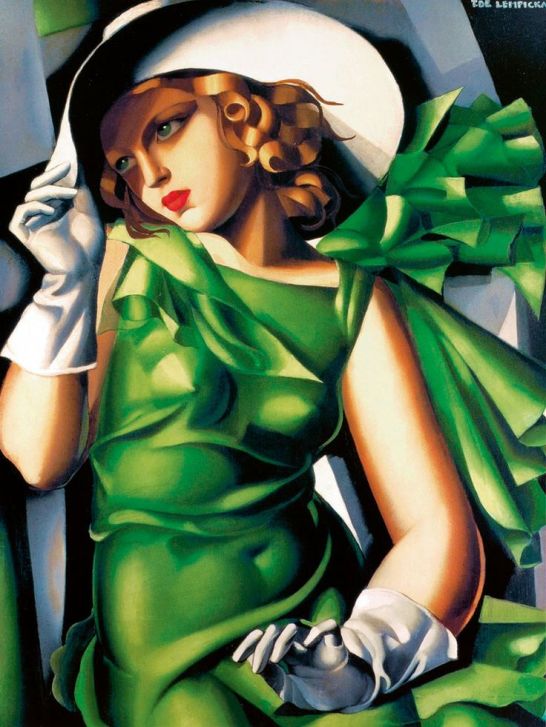
Portrait of Madame M. (1930) – Exemplifying her blend of elegance and sculptural form


Would you like a deeper dive into her specific works or how her art compares to contemporaries like Fernand Léger or Diego Rivera?
Comparing Tamara de Lempicka to her contemporaries reveals how uniquely she merged modernity, glamour, and personal mythology. Here's how she stacks up against key artists of her time:
🎨 Tamara de Lempicka vs. Fernand Léger
Style
Art Deco realism with stylized sensuality
Purist Cubism and Tubism, industrialized forms
Palette
Cool, luminous skin tones, metallics, and jewel colors
Bold primaries, flat areas of color
Subject Focus
Glamorous women, self-portraits, portraits of high society
Workers, machinery, modern life’s mechanical rhythm
Philosophy
Beauty, power, and personal iconography
Humanity's relationship with machines and labor
Visual Impact
Sensual, sleek, polished
Rhythmic, graphic, mechanical
Summary: Lempicka glamorized modernity; Léger mechanized it.
🖌️ Tamara de Lempicka vs. Diego Rivera
Movement
Art Deco / Post-Cubist Realism
Mexican Muralism
Technique
Precision, polish, classic European draftsmanship
Monumental fresco, earthy figures, narrative murals
Themes
Feminine power, wealth, eroticism
Social justice, workers’ struggles, Mexican identity
Stylistic Identity
Eurocentric elegance and elite aesthetics
Political and indigenous nationalism
Common Ground
Both adapted Cubist techniques to figurative purposes
Summary: Lempicka painted luxury; Rivera painted labor.
🖼️ Tamara de Lempicka vs. Georgia O’Keeffe
Artistic Focus
Urban glamour, figure-based
Organic abstraction, nature-based
Tone
Cool and architectural
Meditative and expansive
Feminine Expression
Luxurious, sensual, constructed
Introspective, elemental, intuitive
Iconography
Deco women, fast cars, polished surfaces
Skulls, flowers, desert landscapes
Summary: Lempicka captured the machine-age woman; O’Keeffe captured the spirit of the land.
✨ In Pop Culture Context
You could say:
Lempicka is Gatsby meets Vogue.
Léger is Bauhaus meets Bauarbeiter (construction worker).
Rivera is revolution with a paintbrush.
O’Keeffe is soul in the silence of space.