IpAdapter Test













Details
Download Files (1)
Model description
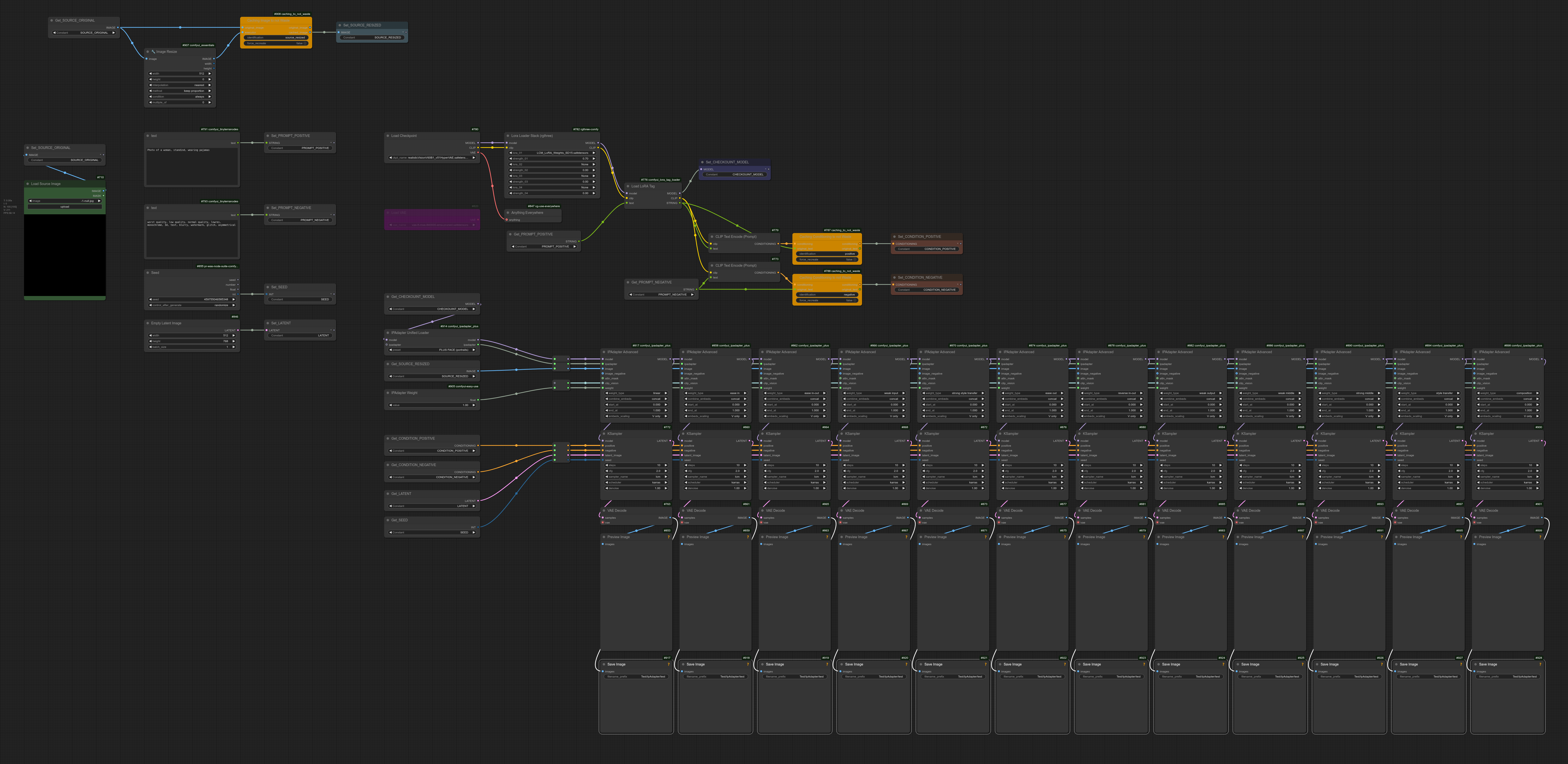
Workflow with the sole purpose of testing each weight_type of the IpAdapter.
This workflow allows us to see each option of IpAdapter's weight_type side by side and determine which is the best choice depending on the intended use.
If you enjoy my work, give me a like, consider leaving a comment or supporting me. I’d really appreciate it! Buy me a Coffee
A brief explanation of each IpAdapter's option:
weight_type – Defines the profile of how the embeddings are applied over time or space:
linear: Applies the weight in a constant and linear manner.
ease in: Starts weak and gradually increases the strength of the weight.
ease out: Starts strong and softens over time.
ease in-out: Smooth transition at both ends (start and finish).
reverse in-out: The inverse of ease in-out, with emphasis in the middle.
weak input: Applies less strength at the beginning.
weak output: Applies less strength at the end.
weak middle: The strength is lower in the middle of the process.
strong middle: The strength is higher in the middle and lower at the ends.
style transfer: Focuses on preserving the style of the original image, with smooth and gradual emphasis.
composition: Attempts to blend different embeddings in a balanced way, with harmonious transitions.
strong style transfer: Strongly enforces the style embeddings of the reference image.
embeds_scaling – Defines how the embeddings are integrated into the attention mechanism:
V only: Uses only the value vector (V) in cross-attention. Less intrusive.
K+V: Uses both key (K) and value (V). Exerts more influence on the results.
K_V w/ C penalty: Same as K+V, but with a consistency penalty (C) to avoid distortions.
K+mean(V) w/ C penalty: Uses K and the mean of V, with consistency penalty — balances smoothness with control.
combine embeddings – Methods for merging multiple embeddings:
concat: Direct concatenation — simply joins the embeddings along the feature dimension, increasing total size. Preserves all individual information.
add: Element-wise addition — sums the corresponding values of the vectors. Directly blends the representations.
subtract: Subtracts embeddings — useful to highlight differences between them (e.g., style A - style B). Can produce distinct visual variations.
average: Simple average — smooths the embeddings, producing a balanced blend. Less prone to distortions.
norm average: Normalized average — same idea as average, but normalizes the vectors before combining, keeping magnitude consistent among them. Helps prevent embeddings with vastly different weights from dominating the blend.